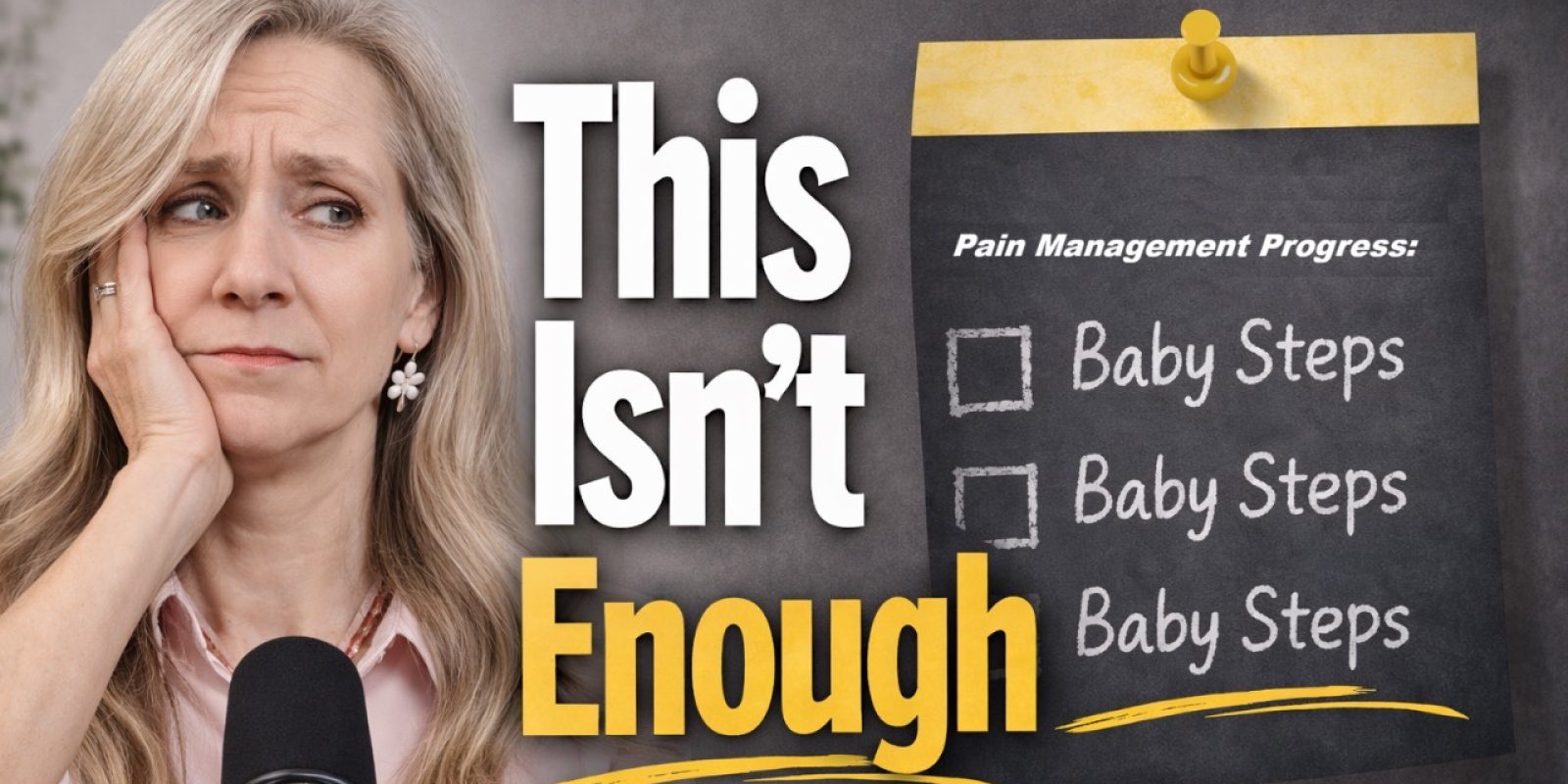
Do you look at your chronic pain struggle and think, “It seems like I’m hardly making any progress. I’ve only made baby steps”?
If so, I want to reframe those seemingly small, insignificant baby steps and help you begin to see them for what they really are: profound baby steps.
Why “Baby Steps” Can Feel Discouraging
When I used to hear the phrase “you’re taking baby steps,” it didn’t sound hopeful. It sounded discouraging. Like, “That’s all I can do? That’s so small. This isn’t going to make a difference.” It almost felt pitiful.
That’s really common. “Baby steps” can feel like a minimizing phrase, one that points out how far away you are from where you want to be. But what I’ve come to understand is that those small steps are not insignificant. They’re actually profound baby steps.
Think about babies learning to walk. We don’t look at them and say, “Wow, that was a small, unimpressive step.” No, we celebrate it. And when they fall, we celebrate that too, because we understand that’s how learning happens. Nobody watches a baby fall while learning to walk and thinks, “Well, I guess walking isn’t working.” We don’t call it a failure. We call it part of the process.
It’s such an important contrast. For babies, we cheer them on, even when they fall flat on their face. But for us adults, we don’t extend the same grace. When we take a small step, we tend to say, “I can only do this much,” or “this doesn’t count,” or “this isn’t really enough.” That mindset is discouraging, because it turns our progress into something that feels meaningless.
The Words You Use Shape the Experience
The language we use matters. Jim and I have taught this in classes and in conversations with clients for years: your brain hears everything you say. What we say shapes how the brain interprets our experience.
One shift that helped me was changing how I talked to myself. Instead of “I can only do this much,” I started saying, “I’m able to do this.” That one change made a big difference.
Another thing that helped a lot was adding one profound little word: yet. Instead of “I can’t do that,” I started saying, “I can’t do that yet.” It’s a powerful shift, because it keeps the door open. It turns a fixed statement, “I can’t do that,” into something that can grow. A lot of my clients love reminding themselves, “I can’t do it yet.” That last word changes us from feeling “I’m stuck” to “this is where I am right now.” Those are two very different statements.
Your Small Steps Are Not Nothing
I want to say this clearly. If you’re taking small steps right now, if you’re doing something that feels tiny, if you’re thinking “this is nothing,” hear me: that is not nothing. That is progress. Your small, seemingly pitiful steps are not pitiful. They’re part of how change happens.
One way I like to think about this is a snowball at the top of a hill. At the very beginning, it barely picks up anything. It might not even look like the ball is changing. But with each roll, it gathers a little more snow, and a little more. Eventually it becomes something much bigger. If you’re at the bottom of the hill, watch out, because that little snowball got a whole lot bigger.
That’s the interesting thing about snowballs. Each roll matters, even the ones that seem small. No single roll looks dramatic. Each one looks kind of pitiful. But every roll is building momentum. That’s exactly what profound baby steps are doing.
Why This Matters So Much With Chronic Pain
This reframe is especially important with chronic pain, because progress on the pain journey is rarely dramatic. It’s usually subtle and gradual.
Even the more significant things, maybe a corner piece of the puzzle like a new physical therapist or a medication that takes the edge off, still aren’t a silver bullet. So in a sense, everything is a piece of the puzzle, and everything is a baby step. If you’re only looking for big changes and ignoring the small ones, you’ll miss the change entirely. You’ll think nothing is happening, when actually a lot might be happening, just in small, quiet ways.
This is all about seeing things differently. Seeing your efforts differently. Seeing your progress differently. Readjusting your view. So instead of “this isn’t enough,” you might say, “this is a step. A profound baby step.” Instead of “this isn’t where I want to be,” you might say, “I’m moving forward.”
One Thing to Take With You
If you take one thing from this, let it be this: your small steps matter. They are not insignificant. They’re not a sign that you’re failing. They’re how change happens.
Just like a baby learning to walk, those steps, even the wobbly ones, are part of building something real. So be patient with yourself, and be kind to yourself. And don’t underestimate what those profound baby steps are doing. They’re more powerful than they look.