Do you ever feel helpless dealing with your chronic pain?
I remember feeling exactly that. I don’t know how to fix my pain. I’m not a doctor. I’m stuck waiting for the professionals to figure it out and fix me.
That sense of helplessness is discouraging, and it’s also a trap. We naturally look for the next right doctor, the next right medicine, the next right procedure, hoping we’ll finally find the silver bullet that cures us. It’s not that doctors, tests, diagnoses, and procedures don’t matter. They do. But placing all our hope in one single solution out there can actually make our pain worse.
One of the most important shifts in going from an unmanaged pain victim to a managed pain thriver is accepting your role as a self-manager in your own pain journey.
What a Self-Manager Is Not
When people hear the term self-manager, they sometimes think, “That means it’s all on me.” That is not what this means at all.
If you don’t feel like you have a role in your pain journey, it’s easy to start believing that nothing will get better. No matter what I do, it won’t help. I feel stuck. That’s paralyzing, and that sense of powerlessness stops people from even trying.
But when we start to see that we actually do have some influence, it creates movement, even if it’s small.
When I talk about feeling like a victim, I mean that feeling of “I don’t have any control here. Nothing I do will make a difference.” And the worst trap of all is believing there’s someone or something out there that will solve it all, if I just keep looking.
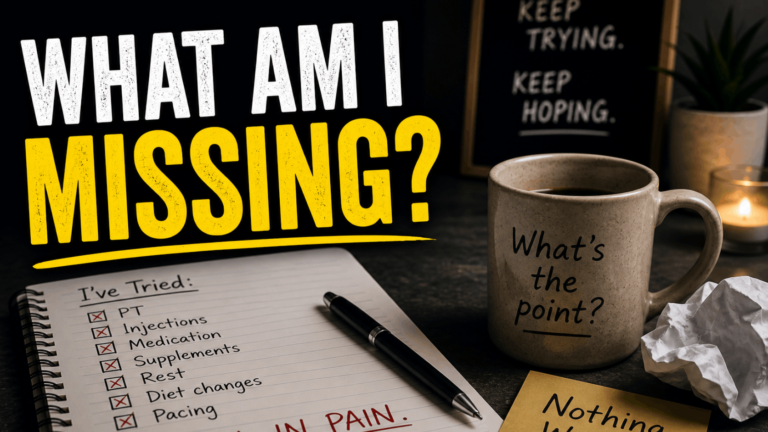
I did that for a long time. Everything depended on finding that one thing. And when that one thing didn’t work, and then the next one didn’t work, and then the next, it was discouraging. It made me feel even more helpless, because I kept looking for the solution that would fix me.
Becoming a self-manager isn’t just changing my attitude from “I’m helpless” to “I can find some resources.” It’s more than that. It’s giving up the trap of searching for one magic solution. It doesn’t mean fixing everything myself. It means building the skills and confidence to live my life even while I’m in pain. And it means becoming an active part of my own health care team.
You Don’t Have Zero Control
Here’s where the shift starts. Recognize that you don’t have zero control.
That’s a bit of a double negative, but it’s the point. You do have some influence. It isn’t a magic solution, but there are things you can do that genuinely make a difference. Baby steps. Pieces of the puzzle.
The turning point for me was moving from “I’m completely at the mercy of this, and there’s got to be a solution out there somewhere” to “I have a role in how I respond.”
Something else mattered too: realizing that I’m the one who lives with this every day. No one else experiences my pain the way I do. Over time, I learned how important it was to keep track of what made it better, what made it worse, what a flare looked like for me, and what my body responded to best.
That made me an expert in my own experience. And it helped enormously. I could communicate better with my providers because I knew what to tell them. I could make more informed decisions about treatments and options. I stopped feeling so lost in the process.
Before, I felt completely alone with nowhere to turn. Then I realized I could turn to myself. There were things I could do.
Thinking Like a Manager
One way I like to think about this is a manager in business. A manager doesn’t do everything themselves. They have people. They gather information, make decisions, and bring in help when it’s needed. But they’re still responsible for guiding things forward.
That shift helped me so much, because it meant I wasn’t doing this alone. I still had doctors, providers, and support. But I had a role too. I was part of the team.
I gave up the idea that the doctors, as important as their role is, were going to fix me. I moved to “I’m involved. I’m an important part of this team.” That made all the difference.
The Skills I Started Building
Once I saw myself as a self-manager, I started building skills.
I learned to observe, understand, and manage my condition and symptoms. Knowing how much my thoughts and emotions affected my pain levels, I started learning skills to work with those. I built problem-solving skills, because let’s face it, chronic pain comes with a few problems.
I learned to manage my schedule better so I was pacing myself instead of pushing until pain stopped me. I worked on maintaining a healthy lifestyle: eating well, moving a little more while taking it slow, building better sleep habits, managing stress. All of those affect pain.
And I started making action plans, small weekly plans about what baby steps I could take that week.
Those are really life skills, not just pain management skills. They apply to living well in general.
Managing Your Life With Pain
This is an important reframe. It’s not only about managing pain. It’s about managing your life with pain.
That doesn’t mean we stop working on pain management. It means recognizing there are so many other pieces to your life with pain, and we’re learning to manage all of it.
Some of these tools might not sound powerful on their own. But many of our clients find that when they feel more in control of managing their life with pain, they actually suffer less too.
It also helps to understand that chronic pain isn’t always predictable. It would be so much easier if it were, because then doctors probably could find the right pill. But there are many pieces to the puzzle, and it doesn’t follow a straight line, because life doesn’t follow a straight line. There are ups and downs, thoughts, emotions, fears, twists and turns. That can be deeply frustrating when we just want it to be “I do this, and I get better.”
Start With “Maybe I Have More Influence Than I Thought”
You don’t have to jump from “I have no control” to “I’ve completely got this.”
You can start with, “Maybe I have a little more influence than I thought.” That’s enough to get you going.
So if you’ve been feeling stuck, or like pain is completely in charge, remember this: you are not powerless in it. You have a role. You have influence. And that’s where change begins.
That role doesn’t mean doing everything perfectly. It just means staying engaged in the process, knowing that your influence really matters.
Be patient with yourself. You’re learning to manage something that can genuinely make a difference.